Applications for pick-to-light order picking
Use Cases
Our use case examples show, how our customized Pick-to-Light solutions make order picking processes significantly more efficient
and offer a wide range of possible applications.
Efficient picking of a wide variety of
accessories
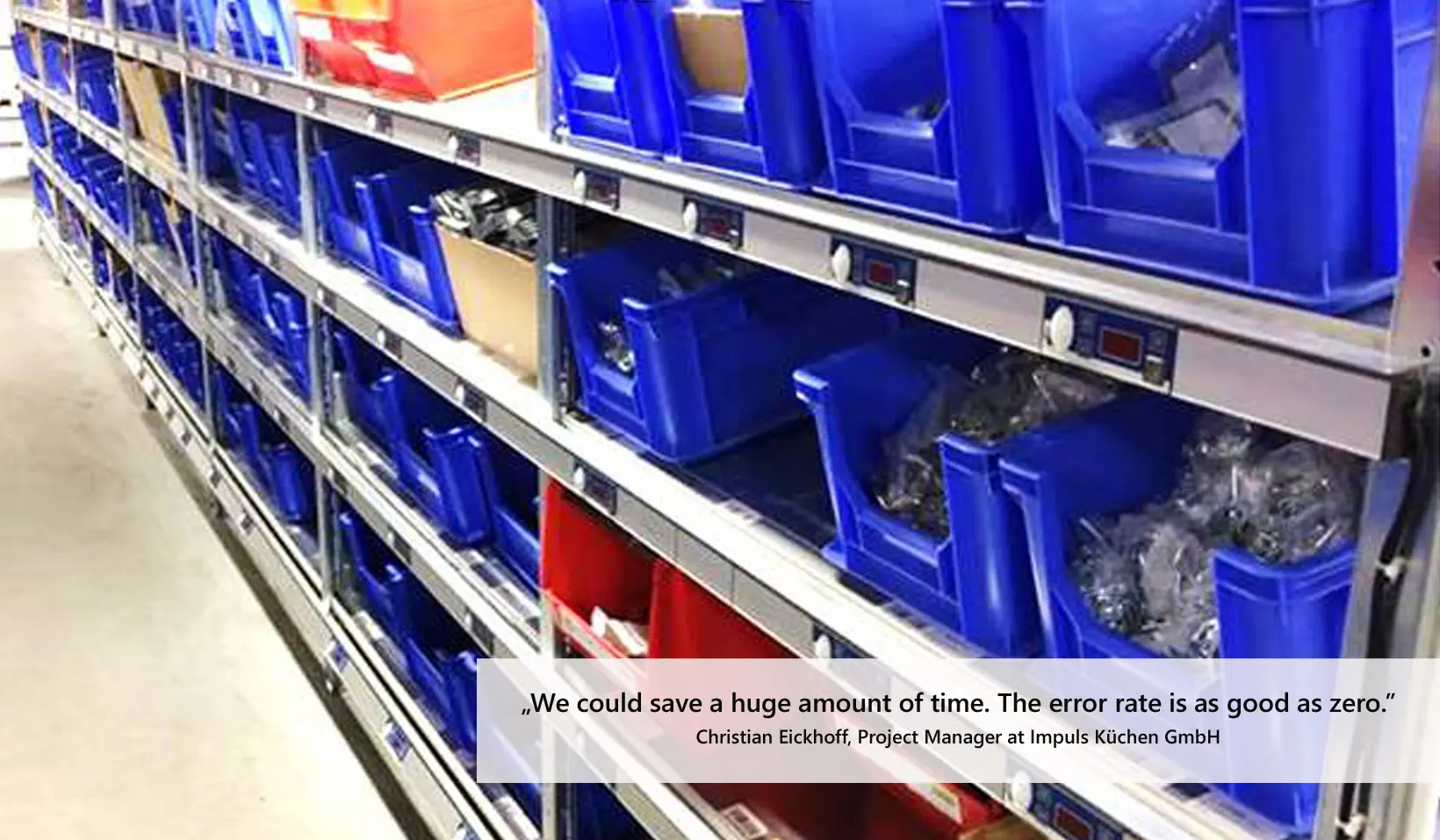
Variety for individualists – with this company motto the German kitchen manufacturer Impuls Küchen GmbH offers its customers a wide variety of options. The company manufactures 730,000 kitchen cabinets annually. However, this competitive advantage in terms of customer and market appeal presented new challenges for production logistics on a daily basis.
The goal was therefore to enable the picking of customer-specific accessories—such as handles, fittings, and other variant items—quickly, with virtually no errors, and in a transparent manner.
The logistical conditions were demanding:
- Reliable processing of a wide variety of items with changing, customer-specific orders.
- Multiple employees work simultaneously in the same picking zones, which can easily lead to overlapping paths or delays.
- Different access frequencies (fast-moving items vs. infrequently needed items)
- Infrequently needed items must be correctly and clearly identified and retrieved.
In particular, coordinating multiple pickers within the same picking area required a system that enables real-time orientation, transparency, and prioritization.
Implementation of a high-performance pick-to-light system for structured, employee-led order picking:
- Approximately 350 storage locations for fast-moving items were equipped with pick-to-light modules including
multicolor eye-catching lamps and quantity displays in 5 picking zones. - An additional 50 modules with graphic displays serve as a “collective display” for a whole rack.
Multicolor eye-catching lamps for parallel order processing
To enable multiple employees to work simultaneously in the picking area, each picker is assigned their own colour of eye-catching light. This allows multiple pickers to work at the same time—without blocking each other.
If the same item is picked by two different pickers, the signal light flashes in the first picker’s color, thereby indicating the priority of that pick. At the same time, the second picker recognizes that an order is also available for them and can activate it using the module’s function key, thereby “overtaking” the first picker.
Visual Signpost in Picking Zones
At the beginning and end of each picking zone, prominently installed signal lights in the color assigned to a picker indicate whether an order is available for that picker in that zone. If a zone is still occupied by another employee, the picker can immediately move to another zone with an active order.
This enables quick orientation and efficient task allocation.
The introduction of the pick-to-light system made it possible to efficiently organize the complex production of different variants. The combination of intelligent zone control, multicolor technology, and a graphical summary display enables high-performance, error-free order picking.
„We could save a huge amount of time. The error rate is as good as zero.”
[Christian Eickhoff, Project Manager at Impuls Küchen GmbH]
✔ Faster order picking thanks to clear visual signals and prioritization of picks
✔ Simultaneous order picking thanks to multi-color eye-catching lamps
✔ Optimal utilization of picking zones
✔ Significant time savings
✔ Elimination of incorrect picks thanks to precise quantity and shelf displays
✔ Quick orientation and training
✔ Scalable system architecture
✔ Sustainable increase in productivity
Industry: Furniture Industry
Application: Production Logistics – Variant Manufacturing
Increasing throughput and reducing lead
time with pick to light
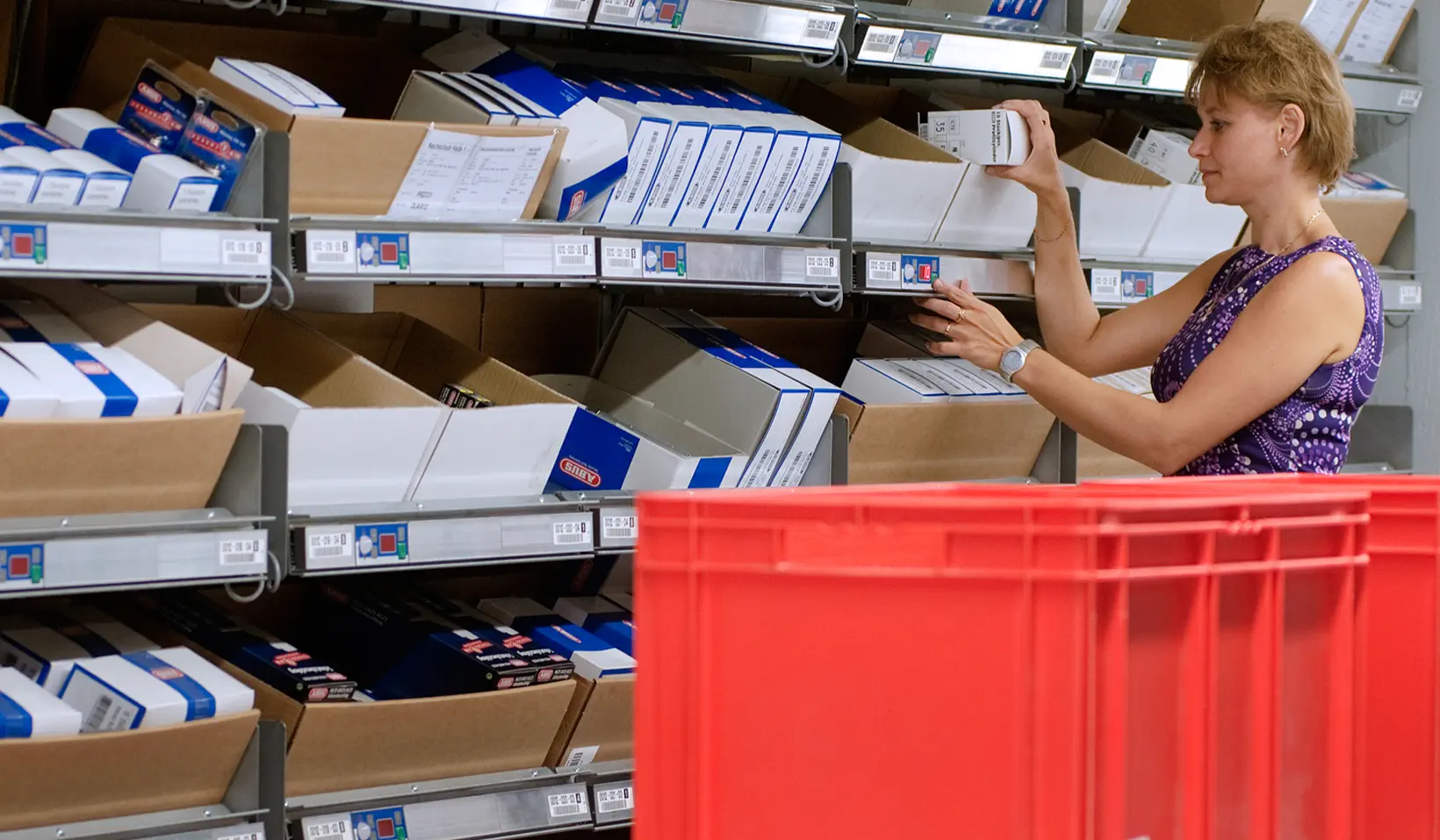
As part of the company’s ongoing growth and a significant expansion of its product range, the security expert ABUS was tasked with restructuring the warehousing and order-picking processes.
Material flow and order-picking performance was to be significantly improved while ensuring an ergonomic work environment for employees.
At the same time, conveyor systems and picking zones needed to be utilized to their full capacity, heavy carton units had to be handled ergonomically, and replenishment had to be controlled without any media breaks. Furthermore, the integration of additional automated storage systems into the existing material flow was crucial to ensuring the continued high performance and scalability of the logistics processes.
ABUS reorganized the entire material flow in the warehouse. A new material flow control system uses conveyor systems to direct the load carriers to their respective picking zones, ensuring optimal utilization.
Faster Order Picking with Improved Ergonomics
To support order picking, a pick-to-light system from KBS with over 2,000 shelf displays was implemented, enabling employees to retrieve items quickly and safely. The 16 picking zones feature seven shelf levels. The shelf displays are ergonomically installed at eye level on the five levels in the middle. When retrieving items from the top or bottom shelf, illuminated directional arrows on the adjacent shelf display guide the process. As a result, all visual signals are always within the employees’ direct field of vision—eliminating the need to bend over or reach up.
Special Mechanical Design to Reduce Operator Fatigue
At Abus, cardboard units weigh up to 40 kg. To make the operators’ work easier, the individual compartments are equipped with a separation mechanism. An integrated brake holds back the cartons following behind. Lifting the compartment briefly (a rocking motion) releases the brake, allowing the next carton to advance in a controlled manner. This reduces physical strain while simultaneously increasing process reliability.
Replenishment supply
Replenishment is also triggered automatically: Every time a withdrawal is confirmed, the inventory in the warehouse management system (WMS) is updated. If the inventory falls below a defined minimum quantity, the high-bay warehouse automatically receives a replenishment request.
Paternoster storage systems
In addition, 20 shuttles were integrated into the order-picking solution. These transport trays to a service opening as needed. In these Kardex shuttle systems alone, more than 7,000 different items can be stored in a space-saving manner and made available as needed.
By implementing a centrally controlled material flow concept, an pick-to-light system for visual order picking support, automated replenishment logic, and shuttle systems, ABUS was able to sustainably optimize material flow, ergonomics, and process efficiency while establishing a high-performance, scalable logistics solution that supports further growth.
✔ Significantly higher throughput and shorter processing times
✔ Reduced strain on employees
✔ Ergonomically optimized picking stations thanks to a display layout that maximizes the field of view
✔ Improved picking quality and customer satisfaction
Industry: Security Technology
Application: Project picking, customer order picking
Scalable Picking for Growing Demands
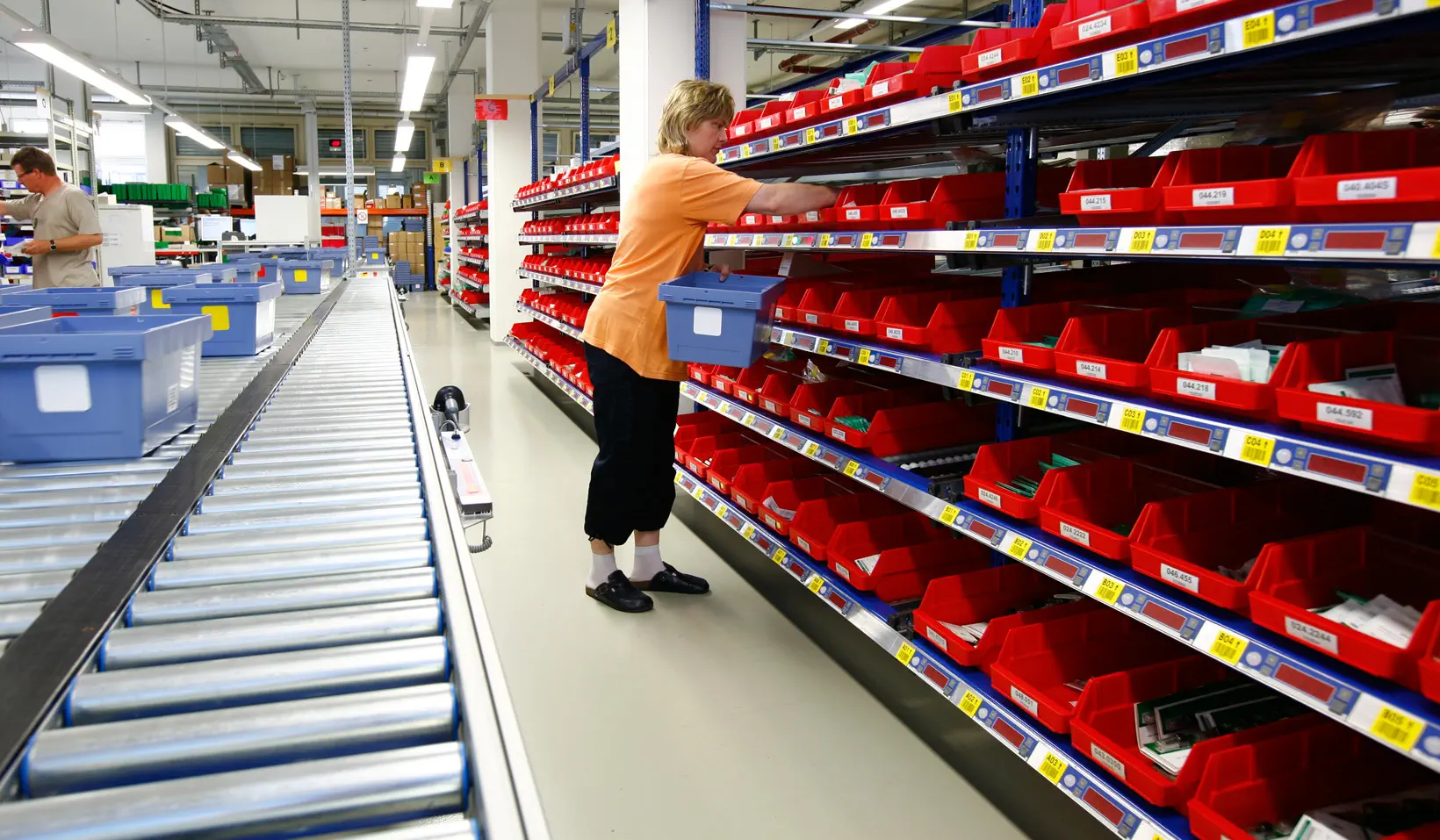
Due to strong sales growth, the dental implant manufacturer Straumann GmbH in Freiburg faced the challenge of designing its intralogistics system to be both efficient and scalable. The goal was to organize order picking and returns processing much more efficiently, reduce error rates, and at the same time be able to respond flexibly to changes in volume and product assortment. In addition, orders were to be processed on a priority basis and completed as quickly as possible after receipt.
The existing paper-based order-picking process using pick lists had reached its limits in terms of both staffing and organization. Every day, more than 1,500 orders with an average of 3.6 items had to be processed—a total of approximately 1.4 million parts per year from a product range of about 1,200 high-tech products. Seasonal order peaks could only be handled by hiring additional staff, whose training took several weeks due to the high level of specialized knowledge required. Processing the industry-standard return rate of around 10% also required a significant amount of manual effort.
Within just a few months, the entire order-picking operation was converted to a modern pick to light system. Approximately 500 shelf displays, zone displays, a material flow computer, new flow racks, and a high-performance conveyor system ensure high picking throughput and a transparent, reliably controlled material flow throughout the entire order-picking process.
Orders Fulfilled Within Minutes
The material flow computer retrieves order data directly from the ERP system, prioritizes it according to the delivery criteria stored in the warehouse management system, and optimizes the order sequence based on the recipient. This allows orders to be processed just a few minutes after they are received.
Easy Putaway of Returns
At the same time, the pick-to-light system also supports returns processing: After scanning a returned item, the pick-to-light system automatically displays the correct storage location. Once the putaway is confirmed by pressing the confirmation button, the item is immediately recorded in the WMS. Putaway is thus system-guided, fast, and reliable.
Greater Flexibility in Workforce Planning
“It only takes 10 minutes to train a new employee to work with the pick-to-light technology.”
[ Stefan Schies, Head of Logistics at Straumann]
Thanks to the semi-automated processes with pick to light, the number of order pickers required has been reduced. The freed-up capacity is now specifically allocated to value-added activities such as quality management and customer service (customer hotline).
Logistics processes have been significantly accelerated and made more flexible at the same time. Orders can be processed within minutes of receipt, and new employees can be brought up to speed in no time, making it much easier to handle seasonal fluctuations.
The project demonstrates how partial automation and intelligent system integration can achieve significant performance improvements in the order-picking and returns processes—while also ensuring greater process stability and future-proofing.
With a payback period of approximately two years, the investment delivers rapid economic benefits—thanks to more efficient processes, higher productivity, and a sustainable reduction in process costs.
✔ Higher picking performance: Significantly increased picking performance through visual guidance.
✔ Fast order processing: Fast, priority-based processing upon order receipt.
✔ Efficient returns storage & greater process reliability: System-guided processes optimize workflows and significantly reduce sources of error.
✔ High flexibility in use of human resources:
• New employees can be trained in just a few minutes.
• Flexible scalability to accommodate growth and seasonal fluctuations
• Reduced staffing requirements despite an increase in orders
Industry: Medical technology
Application: Batch and serial number picking
Low-Error Picking Despite Nearly
Identical Items
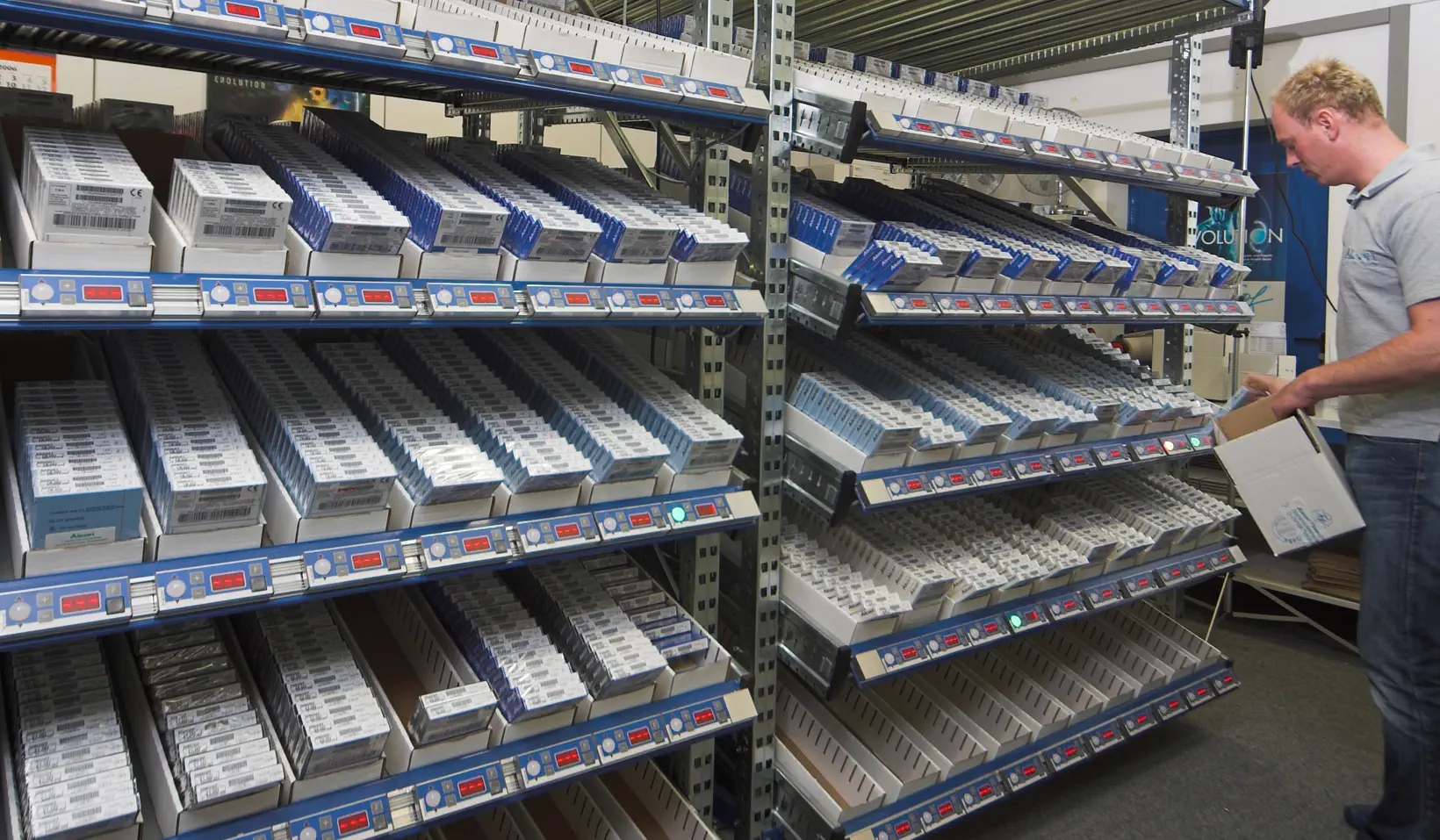
Alcon Pharma GmbH needed a solution to ensure error-free and efficient picking of finished goods in the warehouse. In particular, the company needed to be able to quickly and reliably retrieve several hundred A-line items—with nearly identical packaging—from a flow rack.
With document-based picking, the risk of picking the wrong items was correspondingly high due to the large number of similar-looking items. At the same time, the system had to be flexible enough to allow changes to picking positions without interrupting ongoing warehouse operations.
For this purpose, KBS implemented a flexible pick-to-light system with Snap-On technology. The pick-to-light display modules can be easily removed from and repositioned at a different position on the carrier rail — even during ongoing operations— without losing an active order position. The system consists of a permanently installed carrier profile and flexible display modules connected via a contact rail.
Multicolored eye-catching lamps make it easier to clearly identify picking orders and allow for individual color-coding for different operators. In addition, an audible signal confirms when the confirmation button is pressed, providing improved feedback to the operator during the picking process.
Implementing this pick-to-light solution resulted in virtually error-free order picking while simultaneously increasing picking throughput. Through clear visual and audible user guidance, the system reliably guides employees through order fulfillment. Additionally, the company benefits from a high degree of flexibility in warehouse operations, as the system can be quickly adapted to changing warehouse layouts and picking requirements.
✔ Minimizes the error rate
✔ Maximum flexibility in warehouse layout
✔ Accurate inventory levels through digitization
✔ Flexible scalability
✔ Seamless integration of additional components such as scanner interfaces, etc.
✔ Easy assembly
Industry: Pharmaceutical
Application: Batch and best-before-date picking, item picking
Greater Efficiency in Merchandise and
Store Distribution
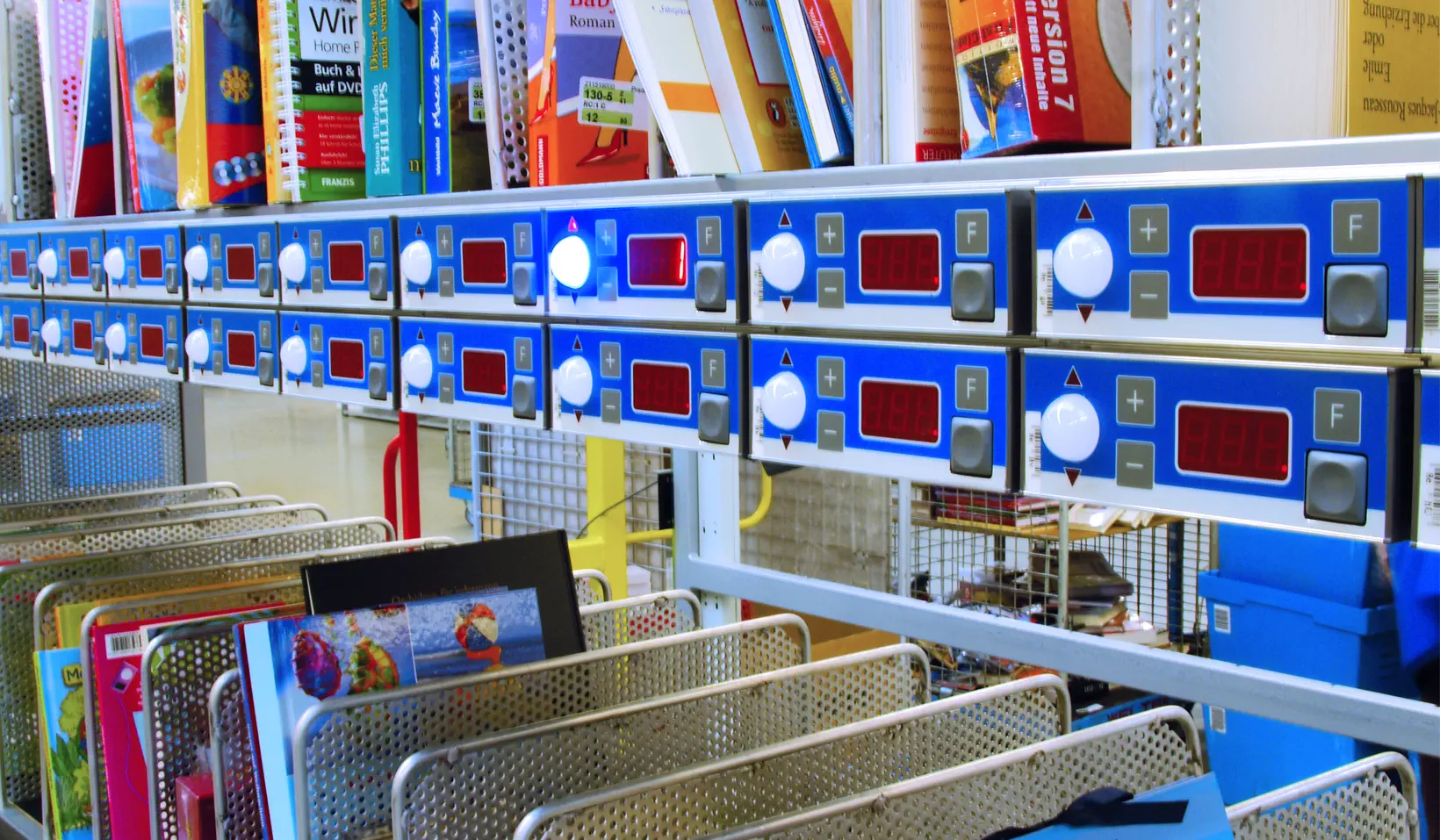
The Weltbild publishing group, an internationally media and mail-order company, wanted to make its merchandise and store distribution more efficient. The goal was to improve sorting accuracy during order picking, prevent incorrect deliveries, and optimize the entire customer order processing workflow.
In the four existing picking zones of the publishing company weltbild, pre-picked goods were sorted into sorting carts from a container delivered via a conveyor system. Hundreds of sorting carts (picking vehicles) were in use for this purpose. The company was seeking a solution that would simplify workflows for staff and significantly increase productivity without requiring a large capital investment. At the same time, the goal was to further reduce the already low error rate.
To optimize the process, a Put-to-Light system was introduced that reverses the classic pick-to-light principle: The pre-picked goods are removed from conveyor bins and assigned to the correct customer compartments on sorting carts via light indicators. Instead of customizing several hundred carts, only 66 stationary sorting racks were equipped with pick-to-light display modules, to visualize the picking orders, and barcode readers — a solution that significantly reduced investment costs.
High Flexibility Through a Customized Solution
To ensure maximum flexibility for the customer, extra-narrow display modules were developed that allow up to 80 orders to be picked simultaneously on a single cart — this significantly increases efficiency, saves travel time, and reduces the need for additional hardware.
With the put-to-light solution, the error rate in order picking was reduced by 50%, while employee productivity was significantly increased. Thanks to the light-guided system, mix-ups — such as the wrong compartment, the wrong order, or the wrong quantity — were virtually eliminated, and time-consuming final checks of orders were no longer necessary.
✔ Unambiguous order assignment via visual light signals
✔ Order picking Error Rate reduced by half
✔ Increased productivity
✔ Maximum flexibility in workflows and work zones
Industry: Publishing
Application: Distribution logistics, store order picking
Efficient Picking of Fast-Moving Items: How
Pick-to-Light Optimally Supports the ASPW
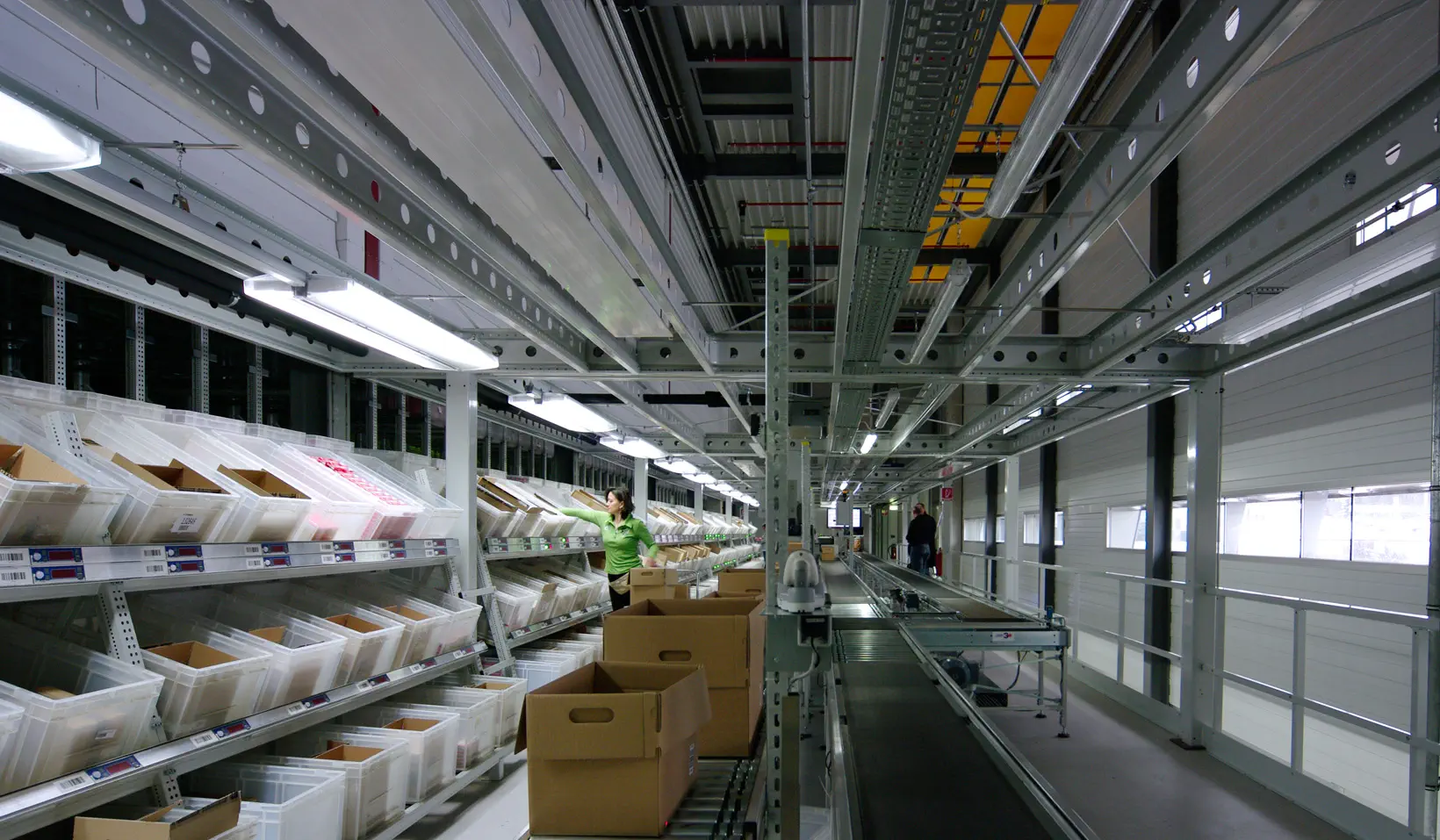
The existing distribution center with an automated small-parts warehouse (ASRS) needed to be expanded following a significant doubling of the picking volume. The goal was to efficiently and reliably handle the growing number of over one million picks per year without disproportionately increasing energy consumption or labor costs. An expansion was intended not only to provide short-term relief but also to offer further growth potential for the coming years.
The existing automated small-parts warehouse had reached its capacity limits, particularly when picking the approximately 350 fast-moving items. The sharp increase in order volume resulted in high additional costs due to multi-shift operations. The company was looking for a scalable solution that would increase performance and flexibility, reduce costs, and significantly improve delivery speed.
Expansion of the automated small-parts warehouse and integration of a “Pick-to-Light” (PbL/PtL) system
To specifically relieve the workload on the automated small-parts warehouse, a pick to light system for approximately 350 fast-moving items was integrated. At the same time, structural and technical expansions were made to the ASRS.
- Four high-performance picking stations with flow racks on two levels specifically handle the fast-moving items.
Employees pick items directly into shipping cartons. - The new pick-by-light system is seamlessly connected to the ASRS via conveyor technology and can be expanded to eight stations as needed.
- In addition, the structure allows for the deployment of two employees per station to handle order peaks when necessary.
- With the expansion to six automated small-parts warehouse aisles, 45,000 storage locations are now available—perfectly positioned for further growth.
The combination of an automated small-parts warehouse (ASRS) and pick-to-light (PtL) technology has created a high-performance, scalable, and cost-effective solution. Productivity and process speed have increased significantly, operating costs have been reduced despite higher order volumes, and same-day shipping has been implemented.
✔ 75 %reduction in the automated warehouse’s travel distance by outsourcing the picking of fast-moving items to a PtL system => significant energy savings and more efficient operation of the automated warehouse.
✔ Two-thirds of all order lines are efficiently processed manually via pick-to-light.
✔ Reduction in labor costs, as picking now takes place in one shift instead of three => savings on night and late-shift premiums.
✔ Increased flexibility through the ability to deploy two employees per station during peak periods.
✔ Significantly faster delivery times: Orders placed by 12:00 PM are ready for shipment the same day => 24-hour delivery
Industry: Stationery and Office Supplies
Application: Customer order picking
Scalable B2C Order Fulfillment with Put-to-Light
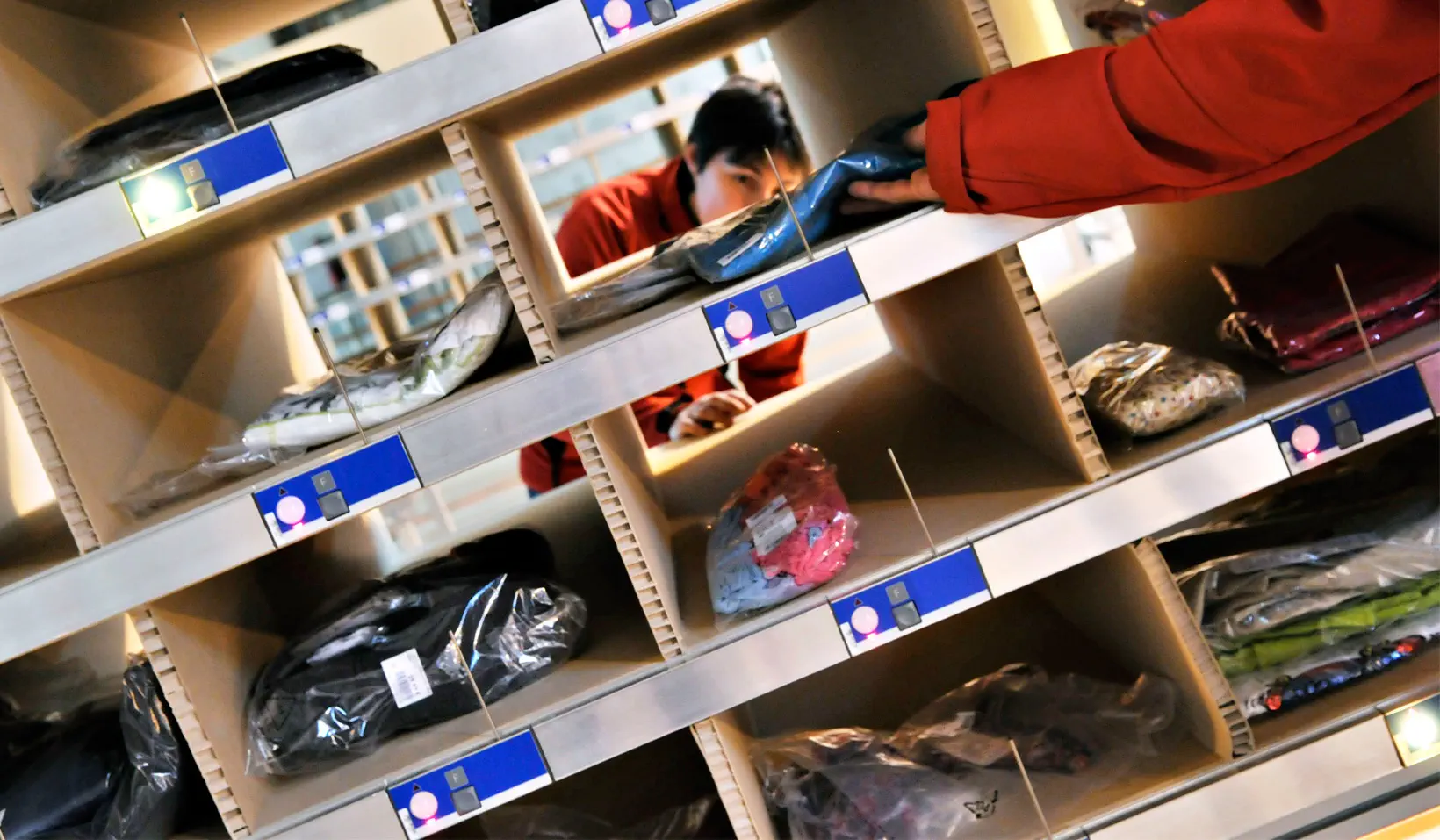
C-Log, a leading logistics service provider specializing in direct shipping of textile items (ready-to-wear, shoes, leather goods, accessories), processes over 57 million items annually, both domestically and internationally.
To meet the growing demands of the B2C business, the picking process needed to be made more efficient. The goal was to increase processing capacity without requiring additional warehouse space or compromising service quality.
Picking B2C orders requires a high degree of flexibility. The processes had to be designed so that:
- fluctuating order volumes can be handled flexibly and efficiently,
- seasonal peaks and individual customer requests (e.g., personalized orders or varying quantities of items per order) can be accommodated,
- high reliability and service quality are maintained
Flexibility and Responsiveness
To optimize the picking of e-commerce orders, a put-to-light system was implemented that is fully integrated into the existing warehouse management system. Depending on the order volume, picking can be carried out simultaneously at one or more picking stations. The intelligently equipped picking stations allow for flexible adaptation to varying workloads. Another advantage is their mobility. This ensures that future reorganizations and expansions of the picking areas can be implemented flexibly.
Ergonomics and Comfort for Employees
Even during the project planning phase, C-LOG placed great emphasis on workplace ergonomics. The new solution has thus significantly reduced employees’ walking and reaching distances.
With the introduction of the pick to light system, C-LOG was able to significantly increase its order-picking capacity. Within just a few months, processing capacity rose from 2,000 to more than 10,000 orders per day. At the same time, the number of shipments increased from 260,000 to one million shipments the following year, without requiring additional space.
The parallel use of multiple picking units boosted productivity while maintaining consistently high reliability and service quality.
✔ Significantly higher productivity: A fivefold increase in picking performance while maintaining the same floor space.
✔ Maximum flexibility: Mobile and modular picking units allow for quick adjustments during reorganizations or expansions.
✔ High reliability and service quality: Stable processes despite growing volumes.
✔ Optimized ergonomics: Shorter walking and reaching distances reduce strain on employees and increase efficiency.
✔ Scalability: The modular system grows with future e-commerce demands.
Industry: Textile mail order
Application: E-commerce fulfillment
Pick-to-Light Technology Optimizes the
Provision of Furniture Hardware
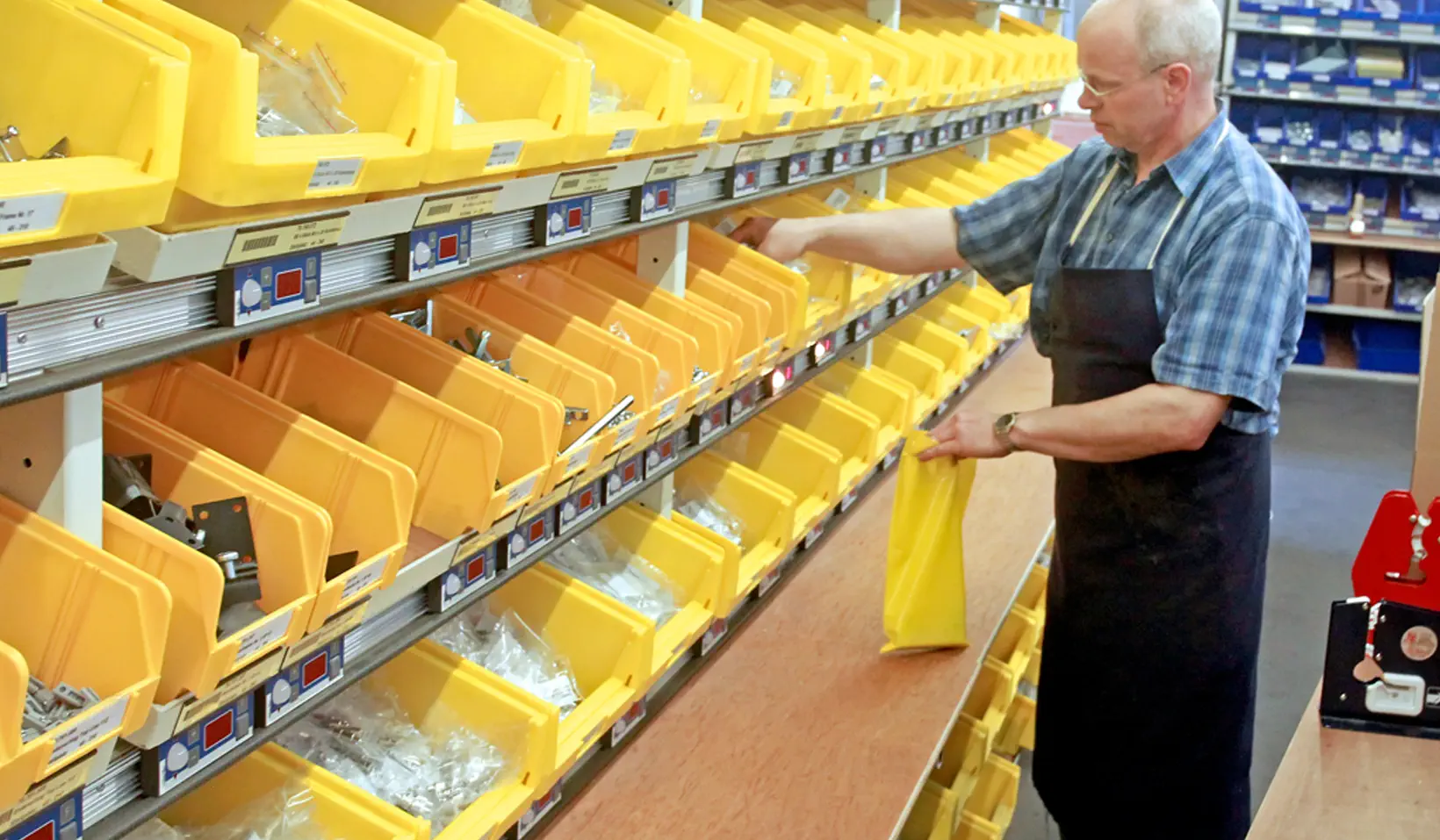
The German manufacturer of high-quality furniture Nolte wanted to make the picking of fixture parts (hardware parts) more efficient, transparent, and less prone to errors. The goal was to optimize the existing organization and provide the parts centrally in a fixture hardware box for each customer order.
The picking process was characterized by a wide variety of fixture parts and multiple product categories. Additionally, there was a need to minimize sources of error, reduce search and walking times, and enable new employees to be trained quickly and efficiently. At the same time, the entire process was to be designed to be transparent and traceable.
To achieve this optimization, a pick-to-light system with a total of 350 picking stations and a clear, structured zone layout was implemented; at the same time, the company switched to a central, order-specific fixture box.
The pick-by-light system was divided into five product zones (fronts, cabinet bodies, dressers, beds, and living room furniture), each with its own zone terminal for displaying messages and status information, ensuring clear workflows and shorter walking times. Equipping each picking station with a three-digit PTF-Shelf-Display featuring an eye-catching light guides employees clearly and productively through the picking process.
This process begins with creating a picking order based on the assembly instructions and the application of shipping labels to the central shipping carton. The order is activated by scanning the barcode.
In each zone, the employee is visually guided to the corresponding picking stations. Each pick is confirmed with the acknowledgement button, and the “end” of the picking order within a zone is displayed on the screen. Once a zone is completed, the employee is directed to the next zone until all required fixture parts have been fully picked into the central box.
High Picking Throughput
In no time at all, all fixture parts for a customer order are packed into a central fixture box — complete, organized, and ready for shipment.
With an average of approximately 6,500 picks per day, the system achieves high performance.
At the same time, it remains flexible and scalable — even as order volumes increase.
Thanks to the system’s intuitive operation, the training period is very short. New employees can be deployed productively within a short time.
With the implementation of the pick-to-light system and the switch to order-specific central cartons, the picking processes were sustainably optimized, creating a high-performance, scalable intralogistics solution that reduces the workload on employees and is optimally tailored to the requirements of a furniture manufacturer with a wide variety of products.
”Not just the price was a selection criterion, but also the consulting and support were also key″ [Alexander Vogt, Project Manager at Nolte]
✔ Structured zone organization by product category
✔ Increased efficiency & productivity
✔ High process speed
✔ Improved delivery quality and significant reduction in complaints => higher customer satisfaction
✔ Bundling of fixture parts simplifies downstream processes
✔ Quick staff training
Industry: Furniture industry
Application: Picking of small parts and furniture hardware
Paperless Assembly for greater
Manufacturing Efficiency at KABA AG
The Kaba Group, one of the world’s leading security companies, wanted to reduce assembly lead times at its production plant while simultaneously increasing the output of digital lock cylinders. To achieve this, a paperless assembly solution was to be created that would provide structured support for the assembly process and enable the one-piece-flow principle.
The assembly of digital lock cylinders involves more than 20,000 possible combinations. Materials, orders, and workflows must be clearly assigned at all times, while multiple employees work in parallel at different stations within the same assembly cell. At the same time, the material flow needed to be designed so that assembly processes could be carried out without unnecessary search or wait times.
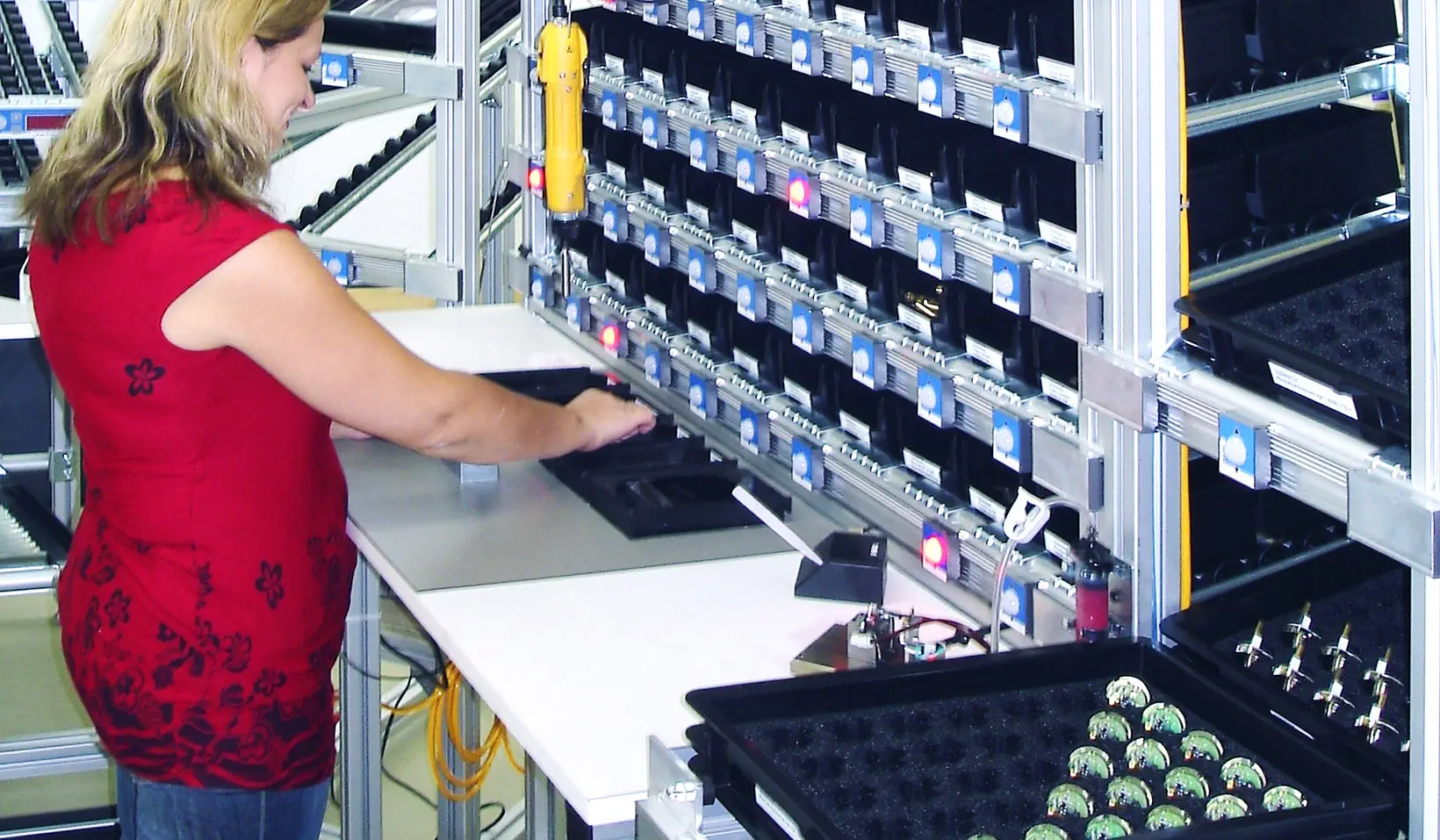
To achieve this, a paperless assembly solution with pick-to-light was implemented. The assembly cell, featuring six workstations, was equipped with 260 shelf displays and 6 zone displays to ensure efficient worker guidance.
Assembly workers use a touchscreen to select their production orders by priority. The orders are broken down into individual tasks, which are processed sequentially. The pick to light system guides employees step by step through the entire assembly process: the pick-to-light displays specifically indicate the correct Kanban bin from which the material is retrieved and assembled directly at the workstation.
Optimization of Workflows Through the Combination of the System and RCID
To control the workflows, the pick-to-light system was combined with the company’s proprietary RCID technology. This technology ensures that each employee is automatically assigned an order item via the RCID transponder they are wearing when they pass the starting station. This assignment remains in effect throughout the entire manufacturing process — from material retrieval to the completion of assembly and packaging — and is only terminated after the final work step by touching the concluding RCID reader.
Increased Work Efficiency
At the six workstations that must be passed through sequentially, the pick-to-light displays relevant to the respective order are automatically activated upon entering or after being scanned by the RCID reader. This allows up to four people to work simultaneously at different workstations within the assembly cell.
Using a pick-to-light solution and its proprietary RCID technology, the company was able to systematically digitize its assembly processes and organize them according to the one-piece flow principle. The desired goals — such as shorter lead times, higher output, and an efficiently organized assembly process — were thus successfully achieved.
✔ 50% increase in productivity
✔ No more setup costs
✔ Single-unit production of various orders/cylinder types possible with up to 4 employees
✔ Average batch size per order: 3 units
✔ Fast and error-free processing of over 20,000 possible combinations
✔ Completely paperless production
Industry: Electronic security technology / Access control systems
Application: Order-based single-unit production using the One-Flow principle